A photo-realistic digital twin will model the pavilion, CAMLs, and ARMs so assembly and disassembly workflows can be simulated, coordinated, and used to validate perception and system behavior before deployment.
About
HARPA investigates how heterogeneous aerial robot teams can enable in-situ prefabricated building assembly. The project combines robotic manipulation, aerial autonomy, digital-twin simulation, and construction-oriented system design to explore a new assembly workflow for future building processes.
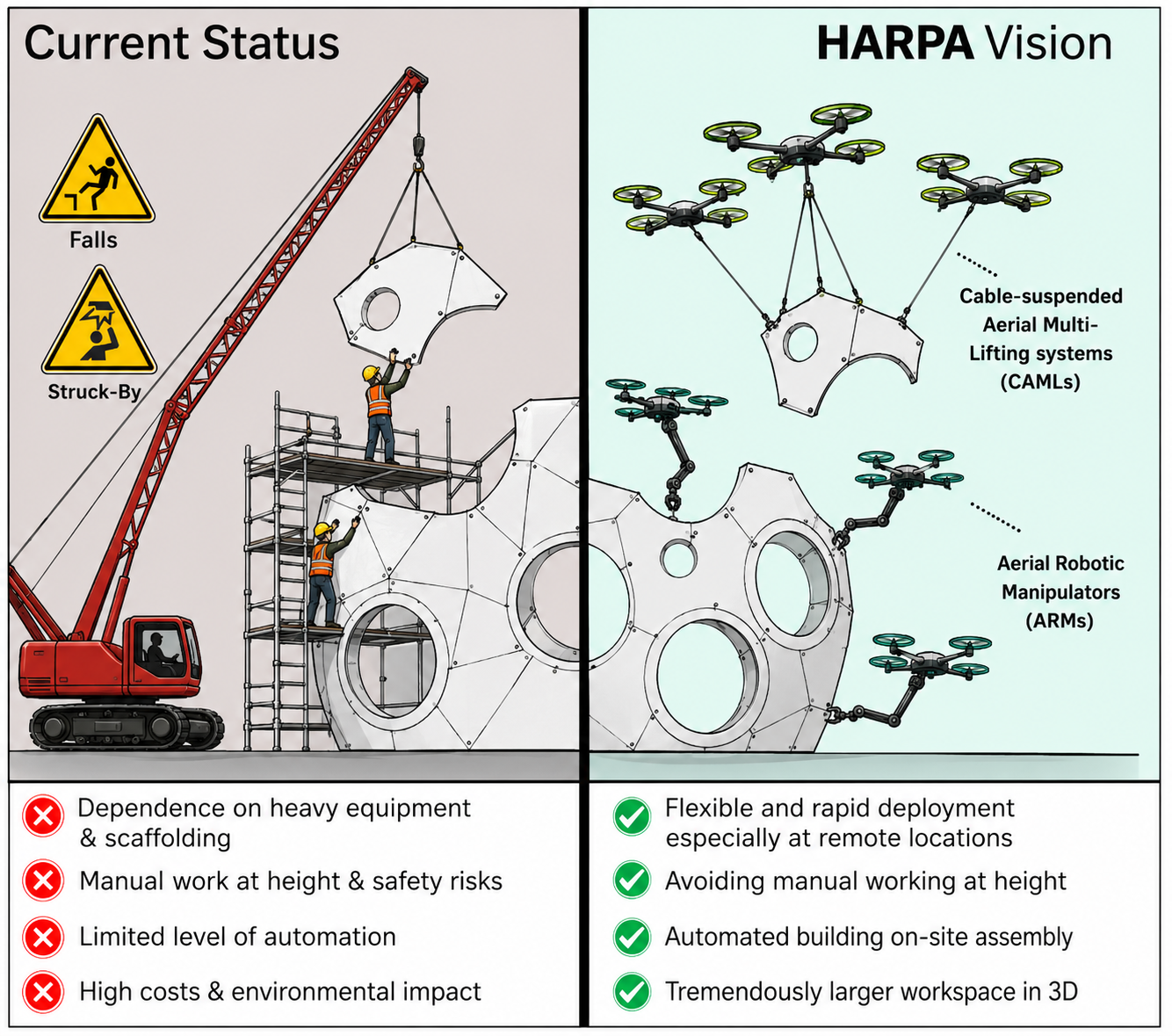
The main objective of HARPA is to develop and demonstrate, at TRL4, an autonomous aerial construction assembly solution that combines Cable-suspended Aerial Multi-Lifting systems (CAMLs) and Aerial Robotic Manipulators (ARMs). The system is designed to assemble human-scale pavilions from prefabricated components, showing how flying robot teams can lift, orient, align, and connect structural elements without relying on cranes, scaffolding, or workers operating at height.
By combining off-site prefabrication with agile aerial assembly, HARPA targets safer and more efficient construction in dense urban areas, remote sites, and other locations where conventional equipment has a large logistical and environmental footprint. The approach keeps people away from hazardous at-height tasks while extending construction automation into complex three-dimensional workspaces.
Outcomes
Each Cable-suspended Aerial Multi-Lifting system (CAML) is a coordinated team of several quadrotor UAVs, connected by cables to a shared prefabricated building component. Together, the UAVs will lift, orient, align, and transport the component with safe force sharing and precise load control.
Cable-suspended Aerial Multi-Lifting systems
Aerial Robotic Manipulators will provide force-capable in-flight manipulation for alignment, pushing, connection, and fastening tasks needed during assembly.
Aerial Robotic Manipulators
HARPA will test scalability beyond the lab through large-scale demonstrations of cooperative CAMLs, including heavy-lift scenarios and controlled load reorientation in construction-relevant settings.
Large-scale demonstrations of CAMLs in the field
The pavilion demonstrator will be designed specifically for aerial assembly, with robot-operable components, reliable connection mechanisms, and stable sequencing for intermediate construction states.
Aerial-robot-oriented pavilion design
Cooperative planning, control, estimation, SLAM, and 4D scene-understanding algorithms will give CAMLs and ARMs the perception and autonomy needed to operate safely in dynamic construction environments.
Perception and autonomy stack and algorithms
Work Packages
WP1 - Overall project coordination
WP1 manages the administrative, technical, legal, financial, data-management, risk-management, quality-assurance, and ethics dimensions of HARPA. It coordinates the consortium, tracks progress against the Grant Agreement, handles reporting and communication with the European Commission, and ensures that project deliverables and governance processes remain on schedule.
WP2 - Pavilion design for aerial assembly
WP2 develops the Aerial-Robot-Oriented Design methodology and applies it to the HARPA pavilion demonstrator. It translates CAML and ARM capabilities into module constraints, defines volumetric and space-frame component systems, and builds sequencing logic for stable intermediate states so the architecture is structurally feasible, robot-operable, and suited to aerial handling and connection.
WP3 - Mechatronics design
WP3 designs and builds the CAML and ARM hardware required for autonomous aerial assembly. It upgrades payload capacity, sensing, winches, hooks, end-effectors, force-torque interaction, and full actuation, while also developing tethered-power solutions to support longer-duration assembly operations.
WP4 - Multi-robot coordination
WP4 develops decentralized and hierarchical coordination algorithms for teams of CAMLs and ARMs. The work covers multi-robot planning and control, safe force distribution, obstacle avoidance, and heterogeneous cooperation in which manipulators stabilize or adjust components lifted by multi-lifting systems under dynamic and failure-prone conditions.
WP5 - Contact-aware planning and control
WP5 focuses on contact-rich aerial manipulation needed for real assembly tasks. It develops force-based pushing, compliant control during contact, teleoperated bolt insertion and tightening, and eventually autonomous fastening strategies based on visual servoing and imitation learning so the robots can move beyond free-flight navigation into precise physical interaction.
WP6 - Multi-robot perception and estimation
WP6 provides the perception and estimation stack for changing construction environments. It extends visual-inertial SLAM to multi-agent and multi-session use, develops 4D scene understanding of geometry, objects, motion, and change, and couples state estimation with the multi-body dynamics of drones, workpieces, tools, cables, and contact forces to support navigation and cooperative manipulation.
WP7 - Digital twin
WP7 builds the digital-twin environment for pavilion design and aerial robotic assembly. It combines structural simulation, high-fidelity robot and contact-aware simulation, photorealistic perception validation, and integrated ROS 2-based system testing so the full assembly process can be analyzed and refined before deployment.
WP8 - Integration and demonstrations
WP8 integrates pavilion components, robotic hardware, perception, planning, control, and digital-twin outputs into end-to-end demonstrations. It moves from submodule tests to iterative pavilion trials and culminates in a public full-pavilion assembly demonstration that validates the HARPA concept as a TRL4 autonomous aerial construction workflow.
WP9 - Scalability exploration
WP9 examines whether CAML concepts and algorithms can scale from laboratory prototypes to heavy-lift construction scenarios. It evaluates the approach in simulation, integrates it with FlyingBasket FB3 drones, adapts low-level control and communication as needed, and demonstrates cooperative lifting and orientation control for construction loads above 200 kg.
WP10 - Exploitation, communication, and dissemination
WP10 maximizes the scientific, industrial, and societal impact of HARPA. It manages publications, selected open-source releases, the website, media outputs, public and stakeholder engagement, and standardization outreach, while also preparing the business planning and exploitation pathways needed for commercialization after the project.
WP11 - Portfolio activities
WP11 ensures HARPA contributes actively to the wider EIC Pathfinder Challenge portfolio. It supports joint governance, collaboration with related projects, benchmarking, market-readiness analysis, and shared exploitation and IP strategy so HARPA can create broader technical, regulatory, commercial, and societal synergies.